By their nature, low voltage, data and telecom lines are not as robust as mains power cables and as such do not carry the same magnitude of lightning current. However, the size of that voltage/current is large in comparison to the system operating voltage and, as such, these lightning induced transients can still cause irreparable and expensive damage.
Since transients can be induced from the large electro-magnetic field created during a lightning strike, care needs to be taken over the routeing of such cables.
When selecting a data, telephone or low voltage protector, extra care must be taken to ensure that clamping performance of the SPD does not impede the data/signal transmission voltage.
SPDs in this category are normally installed “in-line” and they have “dirty” (voltage in) and “clean” (voltage out) terminals, thus extra care must be taken to ensure that input conductors are not connected to the wrong terminal.
Positioning is important too, they should be installed within the cabinet supplying the equipment, and the “clean output” cables should be routed away from the “dirty input” cables. Shielding of cables can also assist in reducing the impact of lightning currents. Similarly, the use of fibre-optic cables will reduce the impact of lightning currents. Although, bonding to earth should take place at both ends of the cable if the fibre-optic cable has a metallic shield.
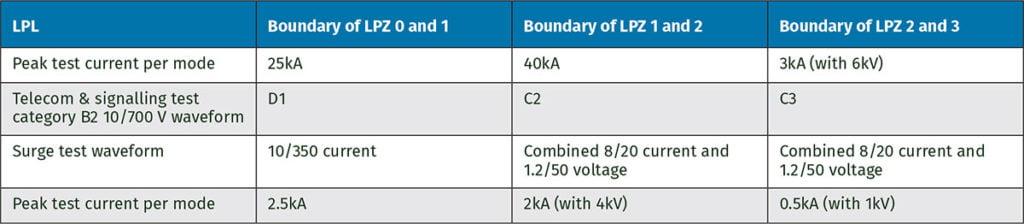
The parameters for low voltage and telecommunication SPDs are outlined in the following tables: